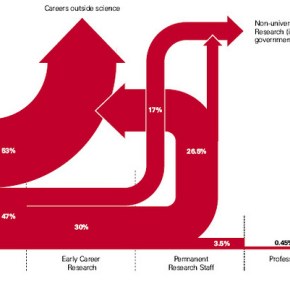
An interesting editorial appeared in the most recent issue of Nature entitled: There is life after academia. In it, the author points out that so called “alternative” careers are in fact the norm for science PhDs. The info-graphic below shows that about one half of one percent of all STEM PhD graduates end up as tenured … Continue reading
Category Archives: Science
Conservation Minded: The Galapagos and changing the focus of conservation practices
What do you think of when you think about the Galapagos? Darwin, finches, tortoises, blue-footed boobys? What else comes to mind? The word pristine, perhaps? How many people do you think live on the Galapagos (a volcanic archipelago owned by Ecuador, but located well off of the coast)? In 1970 there were around 4,000 … Continue reading
New approaches needed for climate conscious policy? How to change unchangeable minds
As a scientist studying issues related to climate change, I have had my share of futile conversation, arguments, and debates with climate deniers. It happens, perhaps too frequently. I recently had one of these conversations with a well-educated, young engineer during a cross-country flight. Said engineer was not so sure that the human impact on … Continue reading
A shrimp tale: how human trafficking in the Thai fishing industry makes buying sustainable seafood even more difficult
Do you eat seafood? Most of us do. It is delicious after all. By now I’m sure you are aware of issues involving sustainable seafood. Not all of the fish we eat are fished (or grown) sustainably (ex: orange roughy ). In recent years, sustainable seafood has been on the minds of many and several … Continue reading
Marine Scientists seeking broader impacts, this post is for you. The Ocean 180 Video Challenge is accepting submissions.
We talk a lot about communicating science, changing perspectives, and increase scientific impact on this site. Today I want to let you all know about a wonderful opportunity to do all of these things– The Ocean 180 Video Challenge . (This is a guest post by Mallory Watson and theOcean 180 team) Publishing your research … Continue reading
Marine Conservation in the News: Top 5 Things Everyone Should Know
Marine conservation has gotten a lot of press lately with President Obama’s plan to extend Pacific Remote Islands Marine National Monument, the release of a new study on seafood fraud, and Leonardo DiCaprio’s pledge to support ocean conservation (Hey Leo, let me know if you are looking for a marine scientist partner!). Here are a … Continue reading
Gotta Catch ‘Em All? The ethics of specimen collection for scientific research
As a coral biologist/physiologist, the ethics of specimen collection for scientific research has been on my mind since day one. We do a lot of destructive sampling in this field. In order to make physiological measurements on a coral, the organism most often be sacrificed. I have seen many a freezer full of collected coral … Continue reading
Science Communication Errwhere! The Top 5 Things I Learned at ComSciCon 2014
This past week, I was lucky enough to attend ComSciCon 2014 in Boston. ComSciCon stands for the “Communicating Science Conference” and is basically a workshop run by graduate students, for graduate students, so we can get together, share ideas, and ultimately become better science communicators. The workshop was a whirlwind of panel discussions, writing sessions, 1 … Continue reading
Film Friday: Voith Hydro Tidal Turbine
A really informative imagination of what developing a tidal energy farm would look like. The concept in this video is actually a little revolutionary when compared with their cousins, wind turbines. These tidal turbines are capable of harvesting the energy from tidal currents in both directions as they ebb and flood, in a fairly linear … Continue reading
Jelly-fied evolution
If you’re reading these words right now, chances are you’re a human (if you’re not, shoot me an email–I have a LOT of questions for you). As humans, our tendency is to organize–to tease meaning out of data. Humans are wired to look for patterns; this is one of the traits that’s propelled our species … Continue reading