Yesterday The European Space Agency (ESA) did something really awesome. They landed a probe on a moving comet. Let’s just think about that for a minute. ESA has been running the Rosetta mission for 13 years and it has traveled over 6 billion Km to reach its destination (Comet 67P). This is obviously much more … Continue reading
Category Archives: Science and Communication
Old Men Go Fishing with Black Line and Spoons
I don’t study fish. It’s one of my limits. I don’t study anything with a face. Or cells. So when I first learned the word “fisheries” I threw it into that chum-bucket of knowledge I’ve grown accustomed to knowing the existence of, but essentially ignoring. But there’s an aspect of fishery study that I connect … Continue reading
Leaving Academia: a perfectly reasonable option for science PhDs
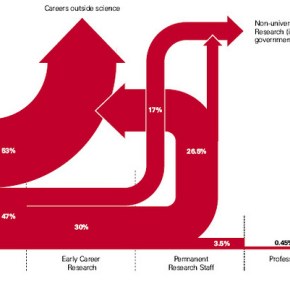
An interesting editorial appeared in the most recent issue of Nature entitled: There is life after academia. In it, the author points out that so called “alternative” careers are in fact the norm for science PhDs. The info-graphic below shows that about one half of one percent of all STEM PhD graduates end up as tenured … Continue reading
Is the “Ivory Tower” Actually a Barrier Against Conservation?
I recently returned from the 2014 International Marine Conservation Congress (in Scotland, which was pretty awesome) where I heard some great marine conservation presentations and met many interesting marine scientists/conservationists. Above all, I was inspired by the themes that were repeated throughout the week, calling on us as scientists to make marine science matter. … Continue reading
New approaches needed for climate conscious policy? How to change unchangeable minds
As a scientist studying issues related to climate change, I have had my share of futile conversation, arguments, and debates with climate deniers. It happens, perhaps too frequently. I recently had one of these conversations with a well-educated, young engineer during a cross-country flight. Said engineer was not so sure that the human impact on … Continue reading
9 ways the “women to STEM pipeline” isn’t enough
Funneling women into STEM majors seems easy enough. Add enough women in the mix, and (like trickle-down economics) those women will get tenure track positions, they’ll encourage the next generation and so on. In a perfect world, if a girl were interested in science, she would study science, and then she would get a job … Continue reading
Changing perspectives in peer review: can double-blind peer review remove biases against women, minorities, and young scientists?
As a grad student I often find myself in conversations with colleagues concerning job prospects, diversity, biases in science, and the difficulties of publishing. I’m lucky to be in a very diverse marine science department full of students from all types of backgrounds. We have more female grad students than male grad students around here, … Continue reading
Breaking: The classic science show you enjoyed as a child is returning!
As a child, there was one thing that could drag me out of bed a whole hour early before the inevitable race out the front door to school: The Magic School Bus. I’m sure you’re wondering what an animated children’s show has to do with marine science. But in the same vein as the recent … Continue reading
Marine Scientists seeking broader impacts, this post is for you. The Ocean 180 Video Challenge is accepting submissions.
We talk a lot about communicating science, changing perspectives, and increase scientific impact on this site. Today I want to let you all know about a wonderful opportunity to do all of these things– The Ocean 180 Video Challenge . (This is a guest post by Mallory Watson and theOcean 180 team) Publishing your research … Continue reading
Science Communication Errwhere! The Top 5 Things I Learned at ComSciCon 2014
This past week, I was lucky enough to attend ComSciCon 2014 in Boston. ComSciCon stands for the “Communicating Science Conference” and is basically a workshop run by graduate students, for graduate students, so we can get together, share ideas, and ultimately become better science communicators. The workshop was a whirlwind of panel discussions, writing sessions, 1 … Continue reading