Reefs at risk- How temperature, policy, and energy needs are harming the Great Barrier Reef
Energy / Energy, News, and Climate / Marine Life / Marine Preservation / News / Policy / Science

Reefs at risk- How temperature, policy, and energy needs are harming the Great Barrier Reef

One of the biggest environmental questions facing our society today is this: Is our reliance on fossil fuels leading to the destruction of natural beauty (and natural resources). If you are a reader of The New York Times, then perhaps you have already seen this amazing piece. It’s a killer piece of long-form written to discuss … Continue reading

Public enemy #1: The climate?
Energy, News, and Climate / Policy / Science

Public enemy #1: The climate?

(Full disclosure, I am partially funded for my graduate studies through the Department of Defense NDSEG fellowship.  This article (and this blog) are not endorsed by anyone, including the DoD. The thoughts and opinions below are my own or properly credited to the appropriate source. Reading on, and reading the linked Climate Roadmap may also help … Continue reading

Social media, special interest groups, and the spread of scientific misinformation
Energy, News, and Climate / Policy / Science

Social media, special interest groups, and the spread of scientific misinformation

I recently read a great blog post about issues with the spread of misinformation via social media. If you are a social media user, I’m sure this is something you are familiar with. How often have you gone on Facebook and seen “16 dead in tragic roller coaster accident in Orlando” all over the page? … Continue reading

Tiny cilia help corals exchange Oxygen and nutrients with the environment
Marine Life / Oddities in the Ocean / Science

Tiny cilia help corals exchange Oxygen and nutrients with the environment

In a new study made available last week via PNAS, MIT scientists (and list of multi-national, multi-disciplinary) collaborators have uncovered that corals can actually manipulate flow near their bodies and are not left to depend solely on the whims of ambient flow. Corals are sessile and depend on flow to exchange nutrients and dissolved gases … Continue reading

Leaving Academia: a perfectly reasonable option for science PhDs
Policy / Science / Science and Communication

Leaving Academia: a perfectly reasonable option for science PhDs

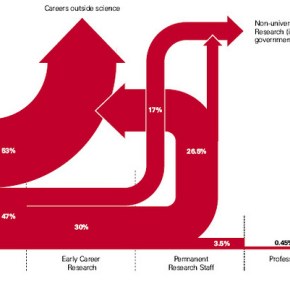
An interesting editorial appeared in the most recent issue of Nature entitled: There is life after academia. In it, the author points out that so called “alternative” careers are in fact the norm for science PhDs. The info-graphic below shows that about one half of one percent of all STEM PhD graduates end up as tenured … Continue reading

Conservation Minded: The Galapagos and changing the focus of conservation practices
Marine Life / Marine Preservation / Policy / Science

Conservation Minded: The Galapagos and changing the focus of conservation practices

What do you think of when you think about the Galapagos? Darwin, finches, tortoises, blue-footed boobys?   What else comes to mind? The word pristine, perhaps? How many people do you think live on the Galapagos (a volcanic archipelago owned by Ecuador, but located well off of the coast)? In 1970 there were around 4,000 … Continue reading

New approaches needed for climate conscious policy? How to change unchangeable minds
Energy, News, and Climate / Policy / Science / Science and Communication

New approaches needed for climate conscious policy? How to change unchangeable minds

As a scientist studying issues related to climate change, I have had my share of futile conversation, arguments, and debates with climate deniers. It happens, perhaps too frequently. I recently had one of these conversations with a well-educated, young engineer during a cross-country flight. Said engineer was not so sure that the human impact on … Continue reading

Changing perspectives in peer review: can double-blind peer review remove biases against women, minorities, and young scientists?
Policy / Science and Communication

Changing perspectives in peer review: can double-blind peer review remove biases against women, minorities, and young scientists?

As a grad student I often find myself in conversations with colleagues concerning job prospects, diversity, biases in science, and the difficulties of publishing. I’m lucky to be in a very diverse marine science department full of students from all types of backgrounds. We have more female grad students than male grad students around here, … Continue reading

A shrimp tale: how human trafficking in the Thai fishing industry makes buying sustainable seafood even more difficult
Marine Life / Marine Preservation / Policy / Science / The HumanitSEAS

A shrimp tale: how human trafficking in the Thai fishing industry makes buying sustainable seafood even more difficult

Do you eat seafood? Most of us do. It is delicious after all. By now I’m sure you are aware of issues involving sustainable seafood. Not all of the fish we eat are fished (or grown) sustainably (ex: orange roughy ).   In recent years, sustainable seafood has been on the minds of many and several … Continue reading

Marine Scientists seeking broader impacts, this post is for you. The Ocean 180 Video Challenge is accepting submissions.
Science / Science and Communication

Marine Scientists seeking broader impacts, this post is for you. The Ocean 180 Video Challenge is accepting submissions.

We talk a lot about communicating science, changing perspectives, and increase scientific impact on this site. Today I want to let you all know about a wonderful opportunity to do all of these things– The Ocean 180 Video Challenge . (This is a guest post by Mallory Watson and theOcean 180 team)   Publishing your research … Continue reading